Case Study — Digital Identity
Dignity, Through Digital Identity
Bridging the trust gap for India's 450 million blue-collar workers through a portable, verified work passport.
- 450M
- Informal workforce
- 22
- Languages designed for
- 5
- Core flows shipped
- Role
- End-to-End UX/UI Designer
- Duration
- Academic Project
- Focus
- Digital Identity, Social Impact
- Sector
- Informal Workforce / India
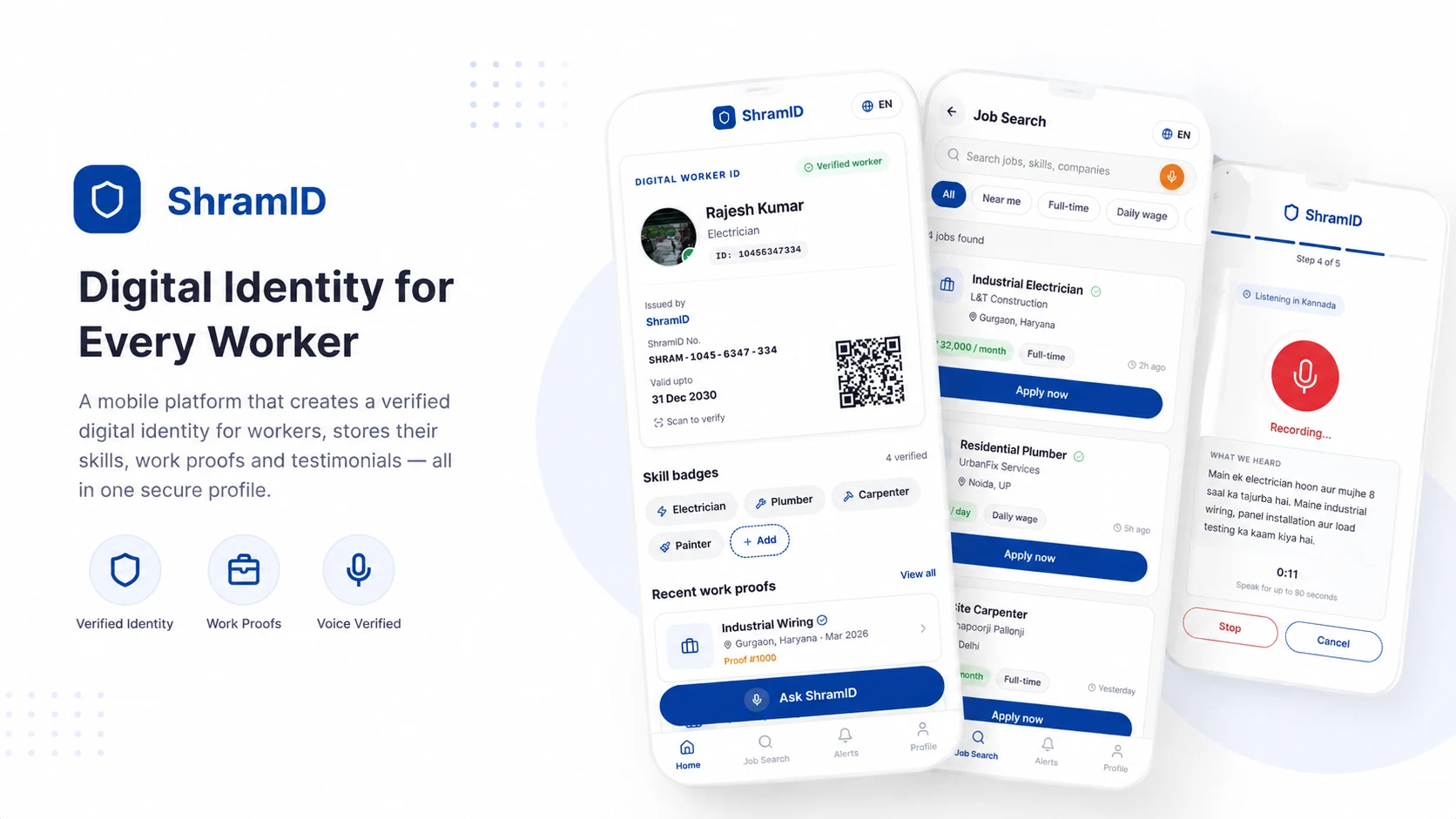
A workforce without a record
India's informal workforce forms the backbone of the economy, yet operates entirely on trust-based, localized networks. Without formal records, career mobility is severely restricted.
"Blue-collar workers lack verifiable work history, keeping them stuck in informal networks and underpaid."
User Problem
Blue-collar workers lack verified work history and struggle to access fair-paying jobs.
Business Problem
Employers lack a reliable system to verify worker credibility and past performance before hiring.
Solution
The platform enables blue-collar workers to carry a portable digital work passport containing verified experience, employer reviews, skill badges, and work history. Employers can listen to audio testimonials or read reviews before hiring, reducing trust gaps in informal labor markets.
Why this needs to exist now
India has one of the world's largest blue-collar workforces, yet hiring largely depends on word-of-mouth referrals. While platforms like Swiggy and Urban Company have normalized digital work profiles, the broader informal sector remains stuck without verifiable work records. With smartphone adoption and digital payments rising rapidly, there is a massive opportunity to provide workers with a portable, digital work identity.
02 · Personas
Target personas
Understanding the unique challenges across different segments of the informal workforce to design a truly inclusive solution.
Segment 01
Domestic Worker
Relies on word-of-mouth referrals across households; no formal record of years of service or reliability.
Segment 02
Security Guard
Repeats verification checks at every new posting; past conduct and attendance rarely carries over.
Segment 03
Construction Worker
Moves between contractors and sites often; wage delays and disputed attendance are common.
Segment 04
Skilled Tradesperson
Has real craft expertise (electrical, masonry) but no channel to prove skill level beyond referral.
Segment 05
Gig / Delivery Worker
Platform-native but locked into a single app's rating system that doesn't transfer elsewhere.
Persona photography and detailed research profiles to be added.
Journey
Raju's journey — from struggle to identity
No record
Raju has 8 years of masonry experience but nothing to prove it beyond word-of-mouth.
Assisted onboarding
A trusted kiosk agent helps him register with Aadhaar verification and a voice profile.
Daily logging
He shows his QR card on site each day; attendance and pay are logged automatically.
Trust builds
Employer reviews and verified days accumulate into a visible, portable trust score.
New opportunity
A new contractor hires him on the strength of his ShramID — no reintroduction needed.
03 · Research
Research insights
Key findings from field studies that shaped the core product philosophy.
I conducted semi-structured interviews with domestic workers and security guards in my residential society, along with construction workers at a nearby construction site. These conversations helped me understand their day-to-day challenges, how they find work, the difficulties they face in proving their experience, and their comfort level with using digital tools.
Social media entry points
Workers are highly active on WhatsApp and YouTube. Leveraging these platforms for onboarding is more effective than standalone app downloads.
Language barriers
English proficiency is low. Voice-first interfaces and vernacular language support are non-negotiable for broad adoption.
Human vs. digital trust
While digital records are useful, workers still seek "human validation" — assisted onboarding via trusted local peers or kiosks bridges the trust gap.
Prevalence of wage theft
Over 60% of interviewed workers reported experiencing delayed payments or wage theft in the past year, highlighting the need for transparent logging.
Identity fragmentation
Workers possess various physical IDs (Aadhaar, Voter ID), but none serve as a verified record of their professional skills and history.
04 · Landscape
Competitive landscape
How ShramID differentiates by focusing on verifiable identity rather than just job matching.
| Feature | Apna | WorkIndia | MyJobee | ShramID |
|---|---|---|---|---|
| Verified work history | Self-reported | Self-reported | Basic | Employer cryptographically signed |
| Skill assessment | Basic quizzes | None | None | Peer & employer validated |
| Portability | Platform locked | Platform locked | Platform locked | Universal digital passport |
| Onboarding assistance | Digital only | Digital only | Digital only | Kiosks & peer-assisted |
| Vernacular voice support | Limited | No | No | Comprehensive AI voice UI |
05 · The Solution
User flows
Five core flows carry a worker from first contact to a re-verified, trusted profile.
Assisted kiosk registration
For workers lacking smartphones or digital literacy. Local trusted agents guide workers through biometric setup and initial skill logging.
WhatsApp self-registration
A voice-first bot experience on WhatsApp allowing workers to create their profile using voice notes in their native language.
Daily use & verification
Workers present their QR code to employers daily to log attendance, receive micro-payments, and build verified work history.
Dispute resolution
Handling discrepancies in logged days or wages through an accessible voice-based grievance system.
Profile re-verification
Periodic re-verification to maintain trust scores, offering flexibility between kiosk visits or app-based selfie checks.
06 · UI Design
Interface & screens
Every screen was designed voice-first: a mic icon sits on nearly every input so a worker can speak instead of type, in their own language.
Onboarding & verification
From first open to a verified ShramID: language selection, phone and Aadhaar verification, a voice-recorded bio, skills, and past employers — capped with an MPIN and a finished digital passport.
Employer confirmation
When a worker adds a past employer, that employer gets a guest link by SMS — no app or login required — to confirm the work and leave a testimonial in one tap.
Daily use
The home base a worker returns to: their digital ID and skill badges up front, jobs matched to their skills, and status updates on proofs and testimonials.
Scan & verify
What an employer sees the moment they scan a worker's QR code: identity confirmation, skills, testimonials (including voice), and certifications — no app login required.
Work proof & trust
Each logged job becomes a verifiable proof with employer testimonials attached — and a clear path to flag a testimonial that isn't right.
07 · Next
Phase 2 roadmap
Building on the foundation of verified identity, the next phase focuses on expanded financial inclusion and upskilling.
Wage tracking
Integrated digital wallets
Transparent, verifiable wage payments directly through the platform.
Micro-learning
Skill & safety modules
Short, vernacular audio/video modules for skill enhancement and safety training, linked to profile badges.
Government integration
Direct scheme linkage
Direct linkage to state and central social security schemes.
08 · Reflection
What I learned
Designing beyond the screen
The success of ShramID lies not in flashy UI, but in understanding the socio-economic context of the user. Bridging the physical-digital divide via local kiosks and physical QR cards was crucial for establishing initial trust before transitioning users to fully digital experiences.
Icons over text
In a low-literacy environment, iconography and voice become the primary modes of navigation. I had to rethink standard UI patterns, replacing complex text menus with universally understood symbols and voice prompts.
Friction vs. feedback
While minimizing friction is a standard UX goal, I learned that introducing deliberate friction (like verifying via OTP or agent) actually increased perceived trust and security among users wary of digital scams.